
Scoring is the heart of All Fives Dominoes. Unlike most domino games where you count pips at the end of a round, All Fives rewards you during play — every time you place a tile that makes the open ends of the layout add up to a multiple of five.
This is what makes All Fives more tactical than games like Mexican Train Dominoes — every placement decision is a scoring decision.
This page explains exactly how All Fives scoring works, with step-by-step examples, doubles rules, end-of-round scoring, and the most common mistakes beginners make.
👉 If you haven’t read the full rules yet, start with All Fives Dominoes Rules first.
The Core Scoring Rule
After you place a tile, add up the open ends of the layout.
If that total is a multiple of five, you score that many points immediately.
| Open end total | Points scored |
|---|---|
| 5 | 5 |
| 10 | 10 |
| 15 | 15 |
| 20 | 20 |
| 25 | 25 |
| 30 | 30 |
| Any non-multiple of 5 | 0 |
Points are scored as you play, not at the end of the round. You track and announce your score after every tile you place.
What Are “Open Ends”?
The open ends are the exposed pip values at each end of the domino layout — the ends that tiles can still be added to.
In a straight layout with two ends:
[3|5] — [5|4] — [4|6] — [6|2]The open ends are 3 (far left) and 2 (far right). Total = 3 + 2 = 5 → score 5 points.
The middle pip values (5, 4, 6) are covered and do not count.
How Doubles Work in All Fives Scoring
This is the part that trips up most beginners.
When a double is played, it is placed sideways across the line. This creates a branch point — tiles can now be added in four directions (left, right, and both sides of the double).
Until all four arms of the double are filled, the double itself counts as both its pip values in the open end total — meaning it counts twice.
Example — Double played mid-layout
Layout before: 3 — … — 5 Player A plays double-5 on the right end (matching the 5).
Now the double-5 is placed sideways. It has two open ends of its own (the two sides of the double), plus the left end of the layout is still 3.
Open ends: 3 (left arm) + 5 + 5 (double, counting both sides until filled) = 13 → no score.
Player B plays 5|2 on one side of the double-5.
Now one side of the double is filled. Open ends: 3 (left arm) + 2 (new end) + 5 (remaining open side of double) = 10 → score 10 points.
Player A plays 5|0 on the remaining open side of the double.
Open ends: 3 (left arm) + 2 + 0 (new end) = 5 → score 5 points.
The double is now fully filled and no longer creates extra open ends.
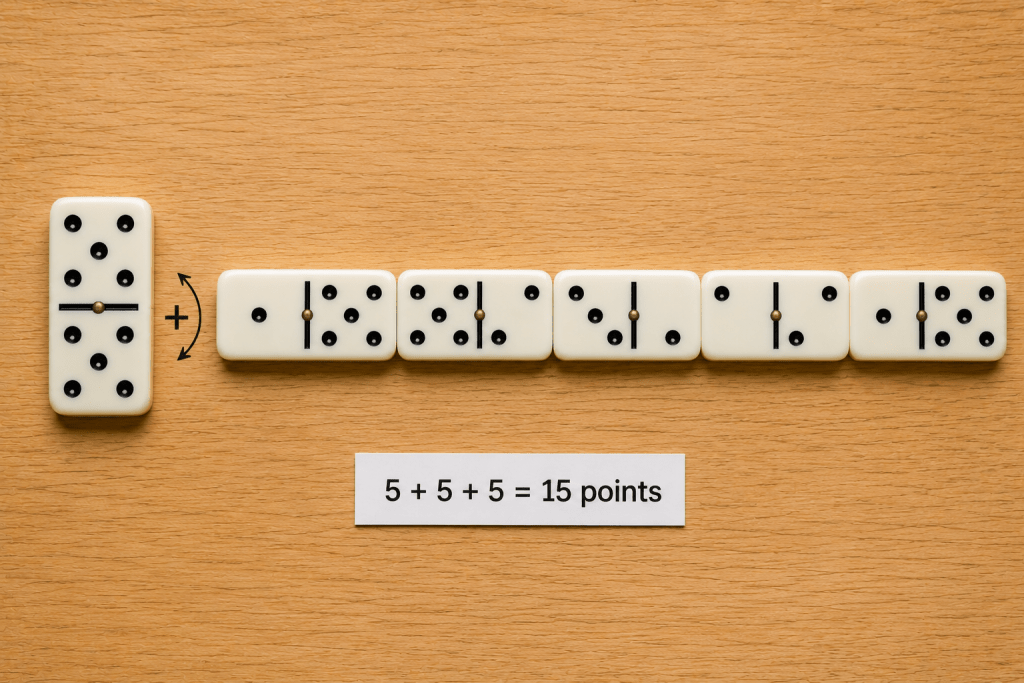
Key rule for doubles
A double counts as both its pip values toward the open end total — but only while it still has open arms. Once all arms are filled, only the new extending ends count.
How to Count Open Ends — The Method
When the layout branches (from doubles), you count all open arms.
Step 1: Identify every end of the layout that tiles can still be added to.
Step 2: Add up the pip values at each of those open ends.
Step 3: If the total is a multiple of 5 — score it.
In a simple straight layout this is always just two ends. Once doubles are played and branches form, you may have three or four open ends to count.
Visual guide to open ends
Simple layout (2 open ends):
[2|4] — [4|5] — [5|3]
Open ends: 2 + 3 = 5 → score 5 ✓
Layout with one double branching (3 open ends):
[3|3]
/ \
[2|4] — [4|3]  (two arms open)
Open ends: 2 + 3 + 3 = 8 → no score
After filling one arm of the double:
[3|3]
/ \
[2|4] — [4|3]  [3|5]
Open ends: 2 + 5 + 3 = 10 → score 10 ✓
End-of-Round Scoring
Scoring during play is the main event in All Fives, but points are also awarded at the end of a round.
When a round ends
A round ends when:
- One player plays their last domino (goes out), or
- The game becomes blocked (no one can play and the boneyard is empty)
Going out bonus
When a player goes out, they score the pip total of all other players’ remaining tiles, rounded to the nearest five.
Example: Player A goes out. Player B has 8 pips remaining in hand. 8 rounded to nearest 5 = 10 points for Player A.
Example: Player A goes out. Player B has 13 pips remaining. 13 rounded to nearest 5 = 15 points for Player A.
Rounding rule: Round to the nearest 5. If the total is exactly halfway (e.g. 7 or 8 rounds to 10, 2 or 3 rounds to 5), most groups round up — but agree before playing.
Blocked game scoring
If the game blocks:
- All players count pips in their hands
- The player with the lowest pip total wins
- They score the difference between their total and each opponent’s total, rounded to the nearest five
Example — blocked game with 3 players: Player A: 4 pips (winner) Player B: 11 pips Player C: 8 pips
Player A scores:
- From Player B: 11 − 4 = 7, rounded to nearest 5 = 5 points
- From Player C: 8 − 4 = 4, rounded to nearest 5 = 5 points
- Total: 10 points
Full Scoring Example — Complete Round
Setup: Player A and Player B. Target score: 100 points. Running scores start at 0.
Turn 1 — Player A plays double-5. Open ends: 5 + 5 = 10 → Player A scores 10. Running: A = 10, B = 0.
Turn 2 — Player B plays 5|3 on one arm of the double. Open ends: 5 (other arm) + 3 = 8 → no score. Running: A = 10, B = 0.
Turn 3 — Player A plays 5|0 on the remaining arm of the double. Open ends: 0 + 3 = 3 → no score. Running: A = 10, B = 0.
Turn 4 — Player B plays 3|2 on the right. Open ends: 0 + 2 = 2 → no score. Running: A = 10, B = 0.
Turn 5 — Player A plays 0|5 on the left. Open ends: 5 + 2 = 7 → no score. Running: A = 10, B = 0.
Turn 6 — Player B plays 2|3 on the right. Open ends: 5 + 3 = 8 → no score. Running: A = 10, B = 0.
Turn 7 — Player A plays 5|2 on the left. Open ends: 2 + 3 = 5 → Player A scores 5. Running: A = 15, B = 0.
Turn 8 — Player B plays 3|2 on the right. Open ends: 2 + 2 = 4 → no score. Running: A = 15, B = 0.
Turn 9 — Player A plays last tile: 2|0 on the left. Open ends: 0 + 2 = 2 → no score. But Player A goes out.
Player B has 9 pips remaining. 9 rounded to nearest 5 = 10 points for Player A.
Final round score: Player A +10. Running totals: A = 25, B = 0.
Strategy Tips for Scoring in All Fives
Count before you place.
Before playing a tile, check what the open ends will be after your placement. If you can reach a multiple of 5, play that tile. If multiple tiles score, pick the highest-scoring one.
Control the open ends.
The best players do not just react to scoring opportunities — they manage what ends are showing to set up future turns for themselves and deny easy scores to opponents.
Doubles are high-value plays.
A well-timed double can immediately hit a multiple of 5 (double-5 played first = 10 points) and force your opponent to deal with three open arms instead of two.
Track your opponent’s hand size.
If they are running low, prioritize going out quickly over chasing a single scoring placement. The end-of-round points add up fast.
Avoid leaving multiples of 5 for your opponent.
If the current open ends total 3 and you are about to place a 2, the ends will total 5 — giving your opponent a scoring setup on their next turn if they can match. Think one move ahead.
Common Scoring Mistakes
Forgetting to score after every tile
In All Fives, you check for scoring after every single placement — not just at the end of the round. Skipping this is the most common mistake new players make.
Miscounting open ends with a double
A double that still has open arms counts as both its pip values. Once filled, it no longer contributes. Many beginners forget this mid-game.
Not rounding the end-of-round bonus
The pips remaining in opponents’ hands are rounded to the nearest 5 before being awarded. Scoring them as exact pip counts is incorrect.
Counting covered ends
Only the ends of the layout that can still receive tiles count as open ends. Middle tiles are not counted, no matter their pip values.
Using end-of-round pip scoring like Mexican Train
In Mexican Train, the loser’s score goes up. In All Fives, the winner scores the rounded pip total of opponents. These are opposite systems — do not mix them up.
👉 For more on how scoring differs across games, see Dominoes Scoring Explained.
Quick Scoring Reference
During play:
- Add up all open end pip values after each tile placement
- If total is a multiple of 5 → score that many points immediately
- Doubles count as both their pip values while arms remain open
End of round — going out:
- Score the pip total of all opponents’ remaining tiles, rounded to nearest 5
End of round — blocked game:
- Player with lowest pip total wins
- Score the difference between your total and each opponent’s total, rounded to nearest 5
Target score: typically 100 or 150 points — agree before playing
Frequently Asked Questions
Do you score on the very first tile?
Yes. If the first tile (usually a double) produces a multiple of 5 at its open ends, it scores immediately. Double-5 played first = 5 + 5 = 10 points.
What if two players reach the target score in the same round?
The player with the higher total wins. If tied, play another round to break the tie.
Does the boneyard affect scoring?
No. Drawing from the boneyard does not trigger scoring. Scoring only happens when you place a tile.
What if I forget to claim a score on my turn?
House rules vary. Many groups allow you to claim it before your opponent’s next turn — after that, the points are lost. Agree before playing.
Can you score negative points?
No. In All Fives, you never lose points for a placement — you either score or you don’t.